
When do you think?
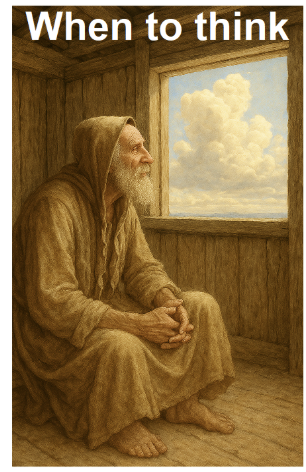
An old mendicant once said “I think all the time. Of warm, dry shelter. Of juicy, delicious food. Of a steaming, hot shower. Of comfortable, peaceful sleep.” We deeply sympathise. But are these thoughts likely to get him those things? Mendicants are people for whom life is harsh, usually unfair. Their backgrounds, luck, education, health and other circumstances have dealt them a brutal hand. They may never have been taught when to think.
If they had been, what should they be thinking about in their dreary little lean-to shelter? ‘How do I escape this disastrous lifestyle?’ might be a good start.
Even though our situation is different from the mendicant’s, the question we might ask ourselves is much the same. We are each in a regime fashioned by parents, intellect, physique, environment and luck. We must use our assets to create the best life they can possibly devise. You can’t knit a pullover with oars. Nor steer a dinghy with knitting needles.
So we think to match our skills with what the world needs in order to support those for whom we are responsible. That usually means family since they are the fount of who we are and the successors to who we will have been. The family as an entity is partly for security. Social animals like to protect those they identify as vulnerable. Family is nearest in line. Many years ago ‘family’ became ‘village’, ‘village’ became ‘state’, ‘state’ became ‘country’ and, lately, ‘country’ became ‘block’. Oh, what an accusatively accurate word that has become!
At each stage of human development we have had to reconcile servicing our instinctive priorities while adapting to growing social demands. When the courier could gallop one hundred miles in three days we established our ties with our neighbours that far away. Our courier is now the internet. It circles the globe many times a minute. That puts our neighbour alongside us. Do we think how this juxtaposition should change how we relate to our neighbours? If we do, what evidence have we got that our purpose is to live at peace?
You and I must think about a million things a day to keep our lives and the lives of those who we care for on some sort of navigable path. If we do not think where that path is taking us we will lose our way. A voyage to nowhere is an alarmingly accurate description.
Where we are going is where we will find our neighbour – more literally today than ever before. Fighting to reach an unknown destination is as pointless as arguing over empty baked bean cans. Scrambling to reach the apex of a topless mountain is absurdity beyond belief.
We are all intellectual mendicants. If the richest and most powerful two intellectual mendicants in the world will explain their rational purpose in leading us and explain where they are leading us to, we will be able to think whether and how to help.
If they won’t, it is even more urgently time to think.
Good morning
John Bittleston
Do you know where they are leading us? If so, please do tell us at [email protected].
17 June 2025