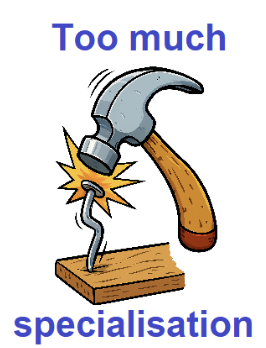
Janan Ganesh hits the nail on the head with his article “The tragedy of specialisation”. His comment that “The hinge between subjects is so often where the gold is” is an alternative definition of creativity to Harmar Brown’s “Ability to perceive relationships”. Every situation is different. Coach and Mentor recognise that their core skill is reading people. So is everyone else’s in a world of communications and persuasions. How well you diagnose, engage, sell, negotiate, entertain and court depends on it. I don’t remember a single class or lecture devoted to the subject in my education. Yet, any successes I have had and all the mistakes I have made have been down to my ability or failure to read people.
Specialisation is a process of checklists designed to ensure there are no mistakes. The theory is that if we follow the rules everything will be OK. In the 1950s while in advertising I wrote a book called “BONES – Business Organisation Notes : Executive Section”. It must seem rather out of date now though I still receive royalties from people copying it. It listed essentials for a number of management decisions.
Life was simpler in those days and management decisions were fewer and well defined. That has changed and the checklists you need today are massive. They are called AI and how massive they are is best described by the power they need to run them. From surgery to sales there are so many variables. AI, and its offspring, Superintelligence, are essentially conformist checklists. Unqualified, they could make real creativity virtually disappear.
That can be avoided if even a few people are enabled to retain their creativity. Think of AI as a regulator rather than a facilitator. That is what it is becoming. Friedrich Hayek, author of WWII book The Road to Serfdom, was right when he said that “always preferring regulation over decentralised markets would lead to disastrous results”. The analogy with AI is valid.
You may wonder where the enormous funds to finance AI are coming from. From you, of course. Bubbles attract investment. So why are so many people convinced about the future of AI? The investment in it exceeds that in any other developing sphere of life. Given the checklist theory I have shown above plus the enslavement of all education systems in the world to ‘doing the right thing’, AI is the lever of control that anyone seeking power will embrace.
It is not universally controllable. The few restraints being imposed on AI are already overwhelmed by bad actors ahead of them even before they reach the statute book. So AI is a specialisation each of us needs to be equipped to handle ourselves. As always that comes down to education and, also as always, education comes down to society’s demands. If society does not see the need for creative freedom – even given the risks it poses – the present young will be robots in less than ten years time.
Whether you believe it or not it is incumbent on every human being to have a point of view about whether such a development is good for humanity. As a species we have done well to develop and keep as much humanity as we have. Is it still developing in the way we want? If not, how do we want it to and why? These may seem questions for a philosopher or academic.
Now they are questions for you and me.
Are you prepared to give an answer?
Good morning
John Bittleston
If you are and if you would like to share it, please tell us at [email protected].
We will owe you a debt of gratitude for ever if you do.
12 November 2025