A useful way of looking at education, both historically and currently, is to see the three distinct but overlapping stages of it: (1) What we have (2) What we need (3) What we want. Whether you take humanity over its 400,000 years or your baby trying to eat what it has found, discovering what we have is the basis of learning. Sorting it into what we need is mostly what we spend our lifetime doing. While doing it we try to find out what we want. As somewhat lazy creatures, we have so far settled for wanting “more”. We are now at a stage where we may soon discover that it really isn’t what we want at all. A surplus of carbon, of money, of people, of energy, of information, even of years on the planet may not satisfy us.
Heraclitus said ‘Much learning does not teach understanding.’ What’s the first thing you must understand when you discover something new? What is it, of course. Then what it does, is it safe, how can we use it and so on through all the questions we have about anything novel. Today we are developed human beings. We have modern physical and mental appendages. We also have the ability to decide what we want to be. Is education equipping us for that?
It is easy to criticise education, which is partly why people do. It is hard to say what education is for, beyond survival. That is why people define it so differently. It is impossible to say who is responsible for education which is why we call it someone else’s job. Educators are trapped between the demands of stardom for their pupils and protecting them from harm. All occupations have this dilemma; few have voracious parents and rapaceous employers at odds with each other to the same extent. That is why strong people need to be in charge of how we educate future generations.
Humanity is at a flexi-point of survival either as amazingly diverse beings or becoming prescribed copy-cat robots without sensitivity. We need to be pushed into self-awareness and into understanding the need to create our own future. Can we / will we do that? Do we still have the courage to teach the basic philosophy of freewill with all its attendant discipline and personal responsibility? In the past we have assumed that this was learnt from parents and priests. But many parents are at work and many priests are hiding from the realities of life.
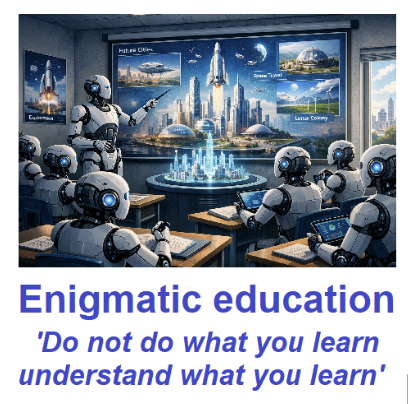
“Education is what is left when everything that has been learnt has been forgotten”. This enigmatic remark is often attributed to Einstein. It begs the question of what education is, as you can see. I do not see it as answerable except through the concept of choice or freewill as I’ve identified it earlier. Freewill is constrained by resources. If the planet survives the climate crisis – it most likely will – resources will become practically unlimited.
Are our education purposes and methods equipping our great grandchildren to answer the question ‘What do we want?’ If not, I suggest they are abdicating their responsibilities with the possibility of dire consequences.
And their responsibilities are our responsibilities.
Without question.
Good morning
John Bittleston
How would you improve education to suit the coming opportunities? Please tell us at [email protected].
18 May 2026