A religion is a search for truth beyond proof. When its objective is to help all humans to decently handle the vicissitudes of life it is valuable. You do not have to believe everything a religion says or does to respect its integrity though some religions have required overt belief as entitlement of membership. Perhaps they still do – it’s not very clear. Established religions have influenced, and still influence, humankind’s development, generally for the good. Not always. Violent insistence that a religion is right says little for a Divinity of goodness.
Whether religions are divine or human institutions they are managed by humans. As such their operation depends on controls of various sorts. The greater the number of followers, the greater the controls needed to discipline declared beliefs and symbolic practices. People also believe in the power of numbers so the followers of a religion give it a certain credibility, though one I regard as mostly spurious. I’ve seen several small groups right and too many large groups wrong to be convinced that bulk is normally anything other than a mob.
Religion is political just as being a human is political. What an appalling mistake we have made pretending that some people are political and some aren’t. “Politics is the practice and study of how power is organized, exercised, and contested within societies” Chat confidently assures us. Everything we do is political. Whether a Pope talks or a farmer in the Scottish Highlands speaks, what they say is political. A pity we don’t all realise that.
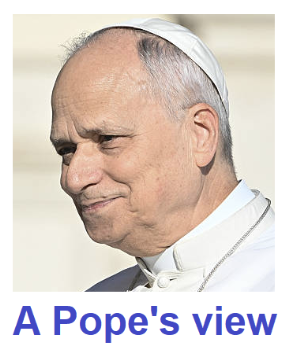
Pope Leo has said that in his (human) opinion the advancement of AI as a weapon or a control of war is getting out of hand. In fact, it is already out of hand. We could today have a terminal planet war without a single human being involved in its planning or execution. Pope Leo is seeking AI’s lethal force to be outlawed, the powers controlling AI to be diffused, truth, children and education to be protected and human dignity to be valued over efficiency. I don’t suppose there’s a decent human being anywhere who doesn’t want all that, too.
You and I certainly do.
The question is ‘how can we possibly do that?’ Individuals and the community at large have invested gigantic sums of (mostly borrowed) money to get AI to its present stage. That needs to earn its interest and dividend. AI presents opportunities for a version of work revolution unlike anything humanity has seen so far. It is going to make competition for established jobs even fiercer than it already is. In opening up the new world that AI offers it is inconceivable that governance can maintain control. Scope and speed will always outpace regime.
We search endlessly for processes, ideologies, formulae, safety systems, decency and harmony. Every time we come up with a new one it is attacked and often beaten by “bad actors”. Most of us then give up and complain that we have no control. But we do.
The age of system governance is slowly drawing to a close. There is one replacement for it, that is the human conscience. Could we start to observe it, understand it, train it, nurture it, love it and occasionally forgive it? If we did we’d have all the governance we need.
Wouldn’t we?
Good morning
John Bittleston
Please tell us what you think at [email protected]. Thank you.
28 May 2026