The most powerful example of conscience I heard came from a roof thatcher called Alf Tuck. He rethatched a cottage in Dorset, England in 1946. I was with him. He said he thought a bit of work he had done was not quite right. Nothing looked wrong so I said “Can anyone tell?” “Yes”, he replied, “I can tell”. I have accepted this as my conscience guide ever since.
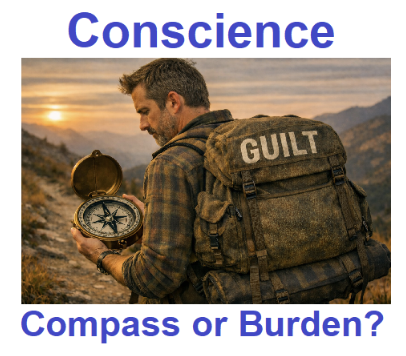
Conscience is not about rigid rules but about responsible awareness. Every choice – from what we do, to how we speak and what we think – influences outwards. Conscience can quieten louder voices of convenience, speed, and self‑interest. It is both Compass and Burden. It guides us to ethical choices as we clash with the pace and pressures of society.
Conscience is becoming more important by the day, and, I suggest, more neglected. We are ignoring the dwindling effectiveness of law as life speeds up, becomes more intrusive via Social Media and is more raucous as we abandon polite language. The law courts are booked way ahead, the prisons are full, legislators can’t keep up with the advances of technologies and still developing AI. Corruption is rife, survival requires increasing ruthlessness, policing is nearly impossible. Even a simple dispute is now regarded as a basis of tort.
The complexities of governance in today’s world are well explained by Ambassador Chas Freeman in his Schiller Institute talk: The Birth, Death, and Prospective Rebirth of the World Order. “The world is suffering a nervous breakdown” he says. Many of us agree.
If 10Bn people are to survive as a Civilisation they must have constraints that work. What used to be local cultures grew into national cultures and are now becoming international cultures. I don’t see AI or even excellent Pope Leo being able to police them. That will come only from each of us understanding and accepting personal responsibility for standards and values. The monitor for such behaviour is our conscience.
It therefore seems a good time to ask what conscience is, what part it plays in our personal makeup, if and how it exercises control of us and what we can do to train it. We shall explore the studies that have been made of it and as we learn more we will write some thoughts about conscience in occasional future Daily Paradox articles.
To tune in to this dialogue I pose a few questions. I’m not hoping for a reply. I just want you to think of the answers for yourself. Of course, if you like to send answers to me they will be treated with total confidence – but I am not seeking correspondence, only thought.
When did you last make a major decision based mainly on your conscience?
What are some of the main issues you face that you allow your conscience to decide?
What situations make you most aware of your conscience?
When have you ignored your conscience yet still had a good outcome of an event?
When have you obeyed your conscience at personal cost and had a good outcome?
How does conscience shape your sense of purpose?
Have you ever thought your conscience was silly or obsessional? About what?
When no one is watching, do you act the same way as when they are watching?
How do you decide what is right when the rules are unclear?
How much do you let others’ opinions shape your moral choices?
Which values do you protect first when they conflict?
How does your personal conscience interact with society’s moral norms?
How has your sense of right and wrong changed over time?
Can your conscience lead to peace after wrongdoing, or only to remorse?
What do you think of the Japanese culture of respect?
You may care to ponder some or all of these questions. Surely no thoughts on conscience can begin anywhere except with ourselves.
And that is where they will certainly end up.
Good morning
John Bittleston
Please always feel free to send views ot [email protected].
1 June 2026