What is leadership? You may well ask. Good leadership is a quiet, steady and confident ‘getting-on-with-it’ and letting those who report to you get-on-with-it-too. You don’t hear much about it because the exponents of it don’t talk much. They ask and listen. Their time is mostly spent doing what the HR Manager would do if they had one. They don’t have one because they realise that they are the HR Manager – regardless of what others are labelled.
They are also the person responsible for Strategy. That sounds an odd mix of jobs but it isn’t. Strategy and Human Resource are one and the same job for any business that employs people. Perhaps we should define the role of leader first. Does the captain of a ship often handle the steering wheel? Does the boss of a business normally negotiate the day-to-day prices of supplies? Do CEOs personally keep track of detailed accounting records?
The answers are ‘No’, of course. So do you know what the word ‘delegate’ means? I’m sure your answer is ’Yes’. Do you have the same answer to ‘Do you delegate work?’ Here’s where it gets tricky. Leaning over someone’s work and constantly correcting them isn’t how you delegate, it’s how you micromanage. People need to know what they are expected to do and then be allowed to do it. That is how they learn to take the initiative and accept the responsibility for what they achieve. It is also how the intelligent ones will offer views on better ways of doing the work. Delegation breeds initiative; micromanagement kills it.
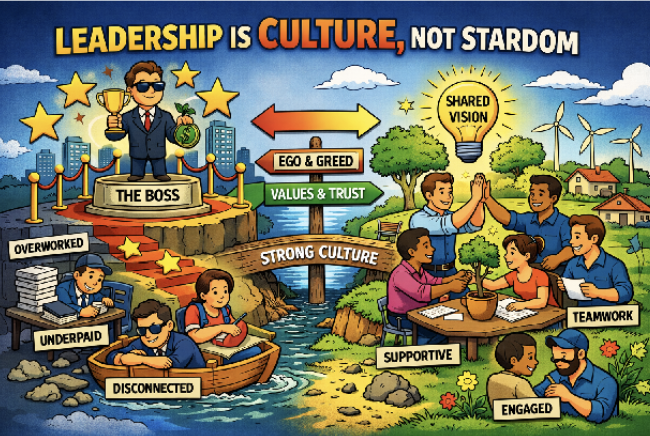
In a recent article in the Straits Times, Singapore’s national newspaper*, Dr Tan Kok Heng sets out with stunning clarity the case for culture over personality in any group, whether commercial, political or social. Everyone should read this article. Dr Tan’s case is made around the success of Cape Verde’s World Cup journey. Most of us can identify with Cape Verde’s role. We are mostly small people struggling in a torrent of grandiosity by those egregious for fame. The truly great leader doesn’t leave his or her imitation-Rembrandt picture for the world to worship but instead endows a culture of care and cooperation.
These are more difficult to assert than competitive speed. Their value is more durable. Unfortunately the word Culture has been surrounded by a range of misleading concepts from Victorian tea-drinking in the parlour to incomprehensibly inventive attempts at brutalising artistic displays of humanity. Culture is how we behave towards each other. The implications of it go beyond that, of course, but the essence of culture is in our minds, is first formed early in life and develops with every thought we have, every word we utter and every thing we do.
The route to culture is hard work. It demands time, patience and clarity. It recognises the fact of two ears, one mouth. It acknowledges that before we are in business we are in life.
It is not known whether a planet can survive without culture.
It might be better to create a decent culture than to find out?
What do you think?
Good morning
John Bittleston
*”What Cape Verde can teach leaders about building winning organisations”. If you can’t get it and want it I have captured a copy of this Straits Times article. Sharing it with you may be illegal but I’m prepared to go to prison for 100 years in order that you should be able to read it.
Apologies for a few weeks with no paradox. I was fighting a lung paradox but have now slaughtered it.
16 July 2026