
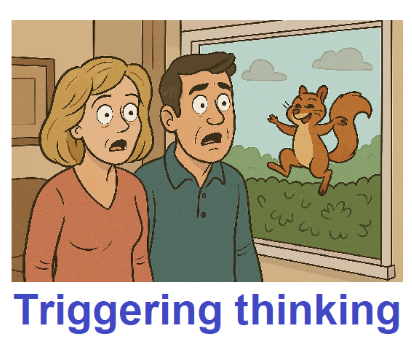
A squirrel dancing on the hedge outside your living room window might make you think.
Just as physical exercise has to start with a plan or programme so thinking cannot always be left to random ideas that flit into your head. That doesn’t mean you have to be exercising your brain all the time but it does mean that you need some discipline if you are to get the best from your mental workouts. Failing a dancing squirrel what can precipitate thought?
Anything can. Take an issue you have at the moment. Something from what to buy your Aunt as a winter holiday present to dealing with threatened world climate disaster. Focus on the issue and apply the questions below to it. I have classified thinking under ten headings. There can be many more, of course, but these are a good start.
The Yawning Gap. If I wasn’t afraid, what would I do? What do I admire in others? What change can I make for the better?
The Nudge. What am I avoiding? Why? How will it look afterwards?
The Jolt. What are my assumptions? What if they are wrong? What if I’m consistently wrong? What rules am I following that are no longer fit for purpose?
The Us. What are the main things I have learnt about life? What are my biggest personal assets and worst personal failings? When did I last review my values?
The Them. What might ‘they’ think? Are you sure?
The Belief. Could I live with this for forty years? What pictures illustrate my beliefs?
The Doubt. Could any of my beliefs be wrong? If so, how? What am I avoiding?
The Paradox. How do I relate the unrelated – the paradox and metaphor of the problem?
The History. What will be thought of what we are now doing in years to come? What will I think I could have done better?
The Onlooker. What would a child, a skeptic, an artist think of what we are doing? What is the smallest change I could make that would have a relatively big impact?
Answer these questions applied to the subject you have chosen and you will be precipitated into a melee of stimulus even Plato would envy. You may not become a world philosopher overnight but you will enjoy tinkering with the answers you give. Few of them will be conclusive. Don’t worry about that. Solutions come when you ponder, not when you race.
The big advantage you will have is that when someone raises a subject you have thought about, your contribution will be calm and considered. You won’t need to pull a trigger and fire off a round of half-baked nonsense. You will have thought about it.
You will have joined the cogniscenti.
You can’t do better than that.
Good morning
John Bittleston
Does it help? We’d love to hear at [email protected]
My next Daily Paradox on thinking will be about the consequences of it.
So it will be called “Conclusive thinking”.
16 August 2025