
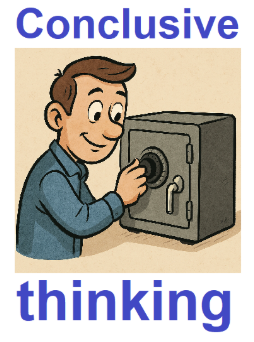
We think in order to decide what to do next. Not all the time but mostly. Our world is one of action. Thinking, musing, pondering, wondering are regarded as passive non-activities. Items to be considered in the twilight of life or when there is nothing more ‘active’ to be done. A great myth of our time is that possessions create more happiness than pondering, that speed proves greater success than subtlety and that facts prove value better than fiction. The best literature and most profound philosophies we have inherited show the opposite.
However, we still have to reach and implement conclusions from our thinking. Business would go bust without them, society would sink into stupor, life would become listless. I can see horror on the faces of those who take the word ‘listless’ literally. Fear not, friends. You shall have glossaries wherever you go. But do you know how to treat a conclusion?
Many don’t. Decision makers are under pressure in a world that has been led to think that speed is a sign of competence. Analysis time, diagnosis of the sick or assessment of a world trend, are often truncated. The Goldsboro (1961), Arkhipov (1962), Petrov (1983) near misses with nuclear bombs were prevented by humans disobeying orders that would have triggered massive planet changing explosions. They were alert but refused to be rushed.
Any conclusion your thinking brings you to must combine these elements of readiness and thought. It must also be the subject of rigorous examination. The questions a conclusion should answer will, of course, vary, but some fundamentals apply to every situation.
Test your conclusions by asking these questions about them:
Does my proposal solve the problem or develop the opportunity I am considering?
Does it go with or against the strategy I have set for what we are doing?
Do I feel in my gut that it is right, or do I feel uncomfortable about it?
What are the best and worst outcomes I can imagine?
Have I accounted for contingent costs of cash, time, energy and reputation?
Who will benefit from this; who might be harmed?
Could I explain this decision to a group of people I respect?
What assumptions am I making; what evidence have I produced?
Could my objective be achieved another way?
If you combine answers to these questions with the questions I set out in The Daily Paradox Triggering thinking (16Aug25) you will have a reasonably good assessment of your project. Will that make your thinking ‘conclusive’? Certainly not. We all have a tendency to want to complete things, wrap them up, lock them away as “done & dusted”. Thinking is the opposite of that. What you conclude must be the trigger for further thought. This is Creative thinking and will be the subject of my next Daily Paradox.
In other words, don’t stop thinking even when you’ve reached a conclusion.
If you do, your thinking is finished.
And so are you.
Good morning
John Bittleston
“If you think you are too small to make a difference, try sleeping with a mosquito.”
the Dalai Lama
I welcome all comments, not just those that agree at [email protected]
Thank you
18 August 2025