
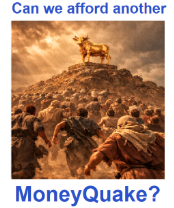
The world is drowning in debt. Who will be asked to pay? Future generations, of course. Debt can be a sound way to finance a project provided the disciplines of affordability are properly observed and the key symbol of goods and services – money – is maintained fairly. Both criteria are now being ignored.
Our financial system will soon have a massive upheaval – a moneyquake. No one knows when. As a child, before we spend money we are taught to ask ourselves ‘Can I afford it?’ Politicians have ignored this question and kicked debt down the road for the next lot to deal with. What does that do to educate the young to be responsible about money?
Due partly to the irresponsible way debt is being handled and partly to the urgent demands of the planet, the question “Can I afford it?” is now less important than another question “Can the World afford it?” This is particularly relevant today when a combination of rearmament, AI investment, assumed rights to health care and ageing populations is making commitments that a few years ago would have been unimaginable. Of all the crazy reassurances that we are now offered, ‘too big to fail’ must surely be the most ridiculous.
We made money our criterion of success – and wealth, our Golden Calf. What has it brought us? Considered most important, the ability to avoid work. At a time when slaves were downtrodden, freedom from slavery, then synonymous with work, was a highly desirable objective. The market for gyms and sports – effort-demanding occupations – tells us that hard work has great rewards.
Two lawyers who gave up the law for hill farming in Scotland said the most rewarding thing they had got out of it was exhaustion. As a former farmer, I agree. But we are being enabled to avoid physical work through robotics and mental work through AI. A half-tuned body and a half-baked brain may be the next sort of human. Are you sure it is what you want?
As I have got older, I have discovered that the things I most enjoyed in life have taken effort, both physical and mental. When I created a new way to solve problems or shine a light on issues that were troubling people, I have been more than rewarded by the knowledge that I did something useful. When I made mistakes I discovered the meaning and joy of learning.
We now have enough wealth to sort out what kind of a society we would like to have. Instead of amassing more and more trillions and faster and faster toys might it be the time to answer the question “What will make us happy?”
If we do, we will learn a lot about our minds and a great deal about ourselves.
And why we are the most interesting creature that ever walked the earth.
Good morning
John Bittleston
Always delighted to hear your views at [email protected].
31 August 2026