
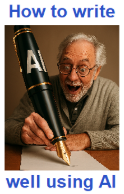
AI is like a wicked uncle – clever, shifty, sometimes too smart for its bootees. But a great source of knowledge, providing it is not hallucinating again. It will help you to write but you must be alert, creative and wary. Here’s how.
What you want to write about must be clear in your mind. Scribble or type some notes to help you think it through. You can change your mind about the subject at any point but you must always be clear about the purpose of your piece. Now comes the first tricky bit – the prompt.
Tell AI as much detail as you can about your subject. AI is the one ‘person’ you don’t need to be concise with. Elaborate to your heart’s content. AI can take it. If you give it muddled instructions, it will try to sort them out for you. It may go adrift doing so. Never mind. Speak politely to it, but correct it. You can also tell it you don’t mind criticism. Language models have been taught to be what passes for kind. In the process they can mislead you terribly.
Read carefully what AI produces. If any facts look wrong, check them, perhaps with another version of AI. See what conclusions AI has brought you to. If they are wooly you will need to toughen them up. Broad generalizations are for the politicians, not for real people. It is at this point that you must decide whether your piece is only for use – to pass information along – or for persuasion and / or entertainment. The former may allow you to use the Ai offering unedited. If your purpose is to convince or sell anything you must edit and reclothe.
I like to try to always include a little entertainment in my writing, however serious it is. Even an obituary shows some colour and light if it is not too boringly stodgy. And I am sure the dear departed would prefer a laugh to a groan. Whether lightening the text or not you should now regard yourself as a tailor’s fitter.
AI’s text will be functional; Shakespeare will not feel threatened by it. You must fit it to your audience and to yourself. You are writing this. Don’t underestimate your audience. Everything you say to them is a lesson. Pitch just a little above what you judge is their intellectual level. They will be grateful that you helped them to exercise their minds.
Read your piece through. Understand it, sense it and above all taste it. No, I don’t want you to eat it. Taste is our most personal and most honest sensation. We should certainly taste our writing, indeed all our communications. Leave your piece alone for a while. Next time you read it you will almost certainly see improvements in the language. Edit your piece. Don’t repeat the same word unless you do it deliberately for effect. Keep your sentences short. In speaking, a pause is a good signal. The full stop is the written equivalent.
Listen to the music of your piece. The written word becomes music when you read it. Is the music strident and gauche or is it melodious and jolly? Try to bring a little Mozart into your writing, or some good, well-rounded pop tunes. Quality of writing is often regarded as irrelevant in business. Don’t you believe it. Well written reports change habits and behaviour; badly written ones get dumped.
Write to your heart’s content but edit like a criminal judge.
You are, after all, passing a lot of sentences.
If you make them snappy you’ll make your readers happy.
Good morning
John Bittleston
Want to show us a piece? Send it to [email protected].
We’ll send you a polite but genuine appraisal. Honest!
24 September 2025