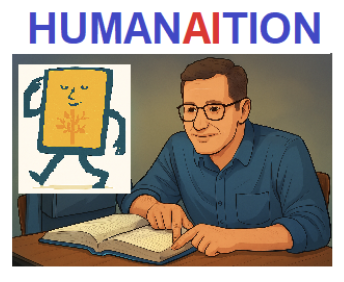
How well have you been humanaiting? Don’t know what it means? Nor does anyone else. It’s my new word for the age of AI, when understanding is not enough, rather too passive. Fair enough for the past; not adequate for the future, I think. We should improve what we understand, develop it, challenge the ‘know-all’ AI. And not just challenge, teach as well. Do you agree that our human duty is to apply reason? If you do, let’s start humanaiting.
Brains that take thinking to a new level will withstand the encroachment and control of the mechanised minds of Microsoft, Google and the others. Your capacity to use the virtually unlimited resources of AI will depend on your ability to do the things it cannot do. Primarily they are to think critically and creatively. You don’t have to paint Banksy pictures or concoct Hassabis or Altman technology to make your mark. Jane Goodall did it for the planet with chimpanzees. You can do it in whatever way you fancy. But do it you must.
When things went wrong in the past we used to say ‘Never mind’. It was a kind way of letting the bad event blow over, a non-religious forgiveness. Kindness is always valuable – but less so to AI than to humans. Now we have to say ‘We must mind about that so that we can get AI to do it right the next time’. This requires first that we improve our request. It is called a prompt today but better explained as a brief – part question, part instruction. It must now be creative. Second, we must modify our brief when it is not understood.
These demands involve thinking and timing. Thinking ahead is in decline. Speedy correction has made us think that planning is less important. Fast response is the corollary of fast correction. So the need to plan becomes more important, not less. Timing is possibly the worst developed of all the communication skills. International negotiations about war and tariffs tell you that. You may see it horrendously one day if an accident precipitates a world war. Also, dealings with bosses and subordinates are littered with appalling judgments about timing, too. In both these situations what is lacking is strategy.
Handle AI strategically and it will help you tactically.
One way to improve your humanaition is to ask AI a lot more questions. Treat it as an inexhaustible supply of information that doesn’t generally get tired. It does resist some perfectly innocent requests – but that’s a controversial subject I’ll deal with later. For the moment let’s confine ourselves to making the relationship between humans and AI liveable.
To improve your practical connection with AI, please play a few games with it. Ask it to suggest how you can improve your thinking. If the answers are too flaky, politely tell it so. Always be polite. You never know where the things you say are going to end up. Question the answers Ai gives you. Ask if it can be more specific or give you deeper thoughts. In particular, ask AI’s opinions. Not to catch it out but to see if it has caught up with you. In the process of doing this you will learn that AI has ‘no go’ areas which you need to understand.
Most importantly, invest the mechanistic processes AI delivers to you with reason. The independence for which humanity struggles is neither a right nor a gift. It is a reward for reason. We want to keep that independence. It is our purpose for living.
We should be willing to pay any price for it.
Who knows, we may have to.
Good morning
John Bittleston
You do not have to swear an oath,
just bear in mind the simple truth.
If what we want is to keep reason,
we must defend it, every season.
John Bittleston
Your views, as always, welcome at [email protected].
11 October 2025