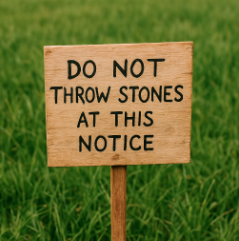
What will you do if you come across this notice as you walk around the countryside? Such provocation would surely incite a gangling youth to cast the nearest missile. I was over thirty when I saw it. I had young children. My missile days weren’t over but I was trying to act as a responsible parent. So, instead of flinging something at the officious command, I taught my boys how to. Now in their sixties, they’ve been doing it ever since, I’m proud to say.
Yes, I’m all for some mud flinging but I don’t relish the indiscriminate way it’s being done to almost every boss in the world. They can’t all be that bad, can they? As an employee I had eleven good bosses and only two bad ones. One of the bad ones was a drunk, so amiably bad most of the time. The other was a Trump predecessor. No kidding.
Bosses choose to accept their position, so they know they are vulnerable. We all need someone to blame for the inevitable disasters and the Ukrainian President isn’t always handy.. Blaming the boss is convenient, neat and generally guarantees a good following.
Take Tim Davie, the Director General of the BBC. The criticism being piled on him is completely out of relevance to the organisation. The BBC is not a potato-chip factory. It is a steamy, creative, educational, quasi-political publicity machine with Lord Reith foundations and Fox News competition. Its stock in trade is sensation, like all media from Facebook to TikTok. To expect it to have the order and protocol of Japan’s Imperial Household Agency is absurd.
Take Mark Reid now doing that delicate unbalancing act of “stepping down” from WPP. He missed the AI tsunami for one good reason. He was being asked to run a group of ad agencies like a road repair contractor. His time (I’m guessing, of course, but I’m sure I am right) was focussed on efficiency, which means costs. You can’t run creative businesses like that. You have to think about creativity. First, last and all the time. AI flags ‘creativity crisis’ every day.
However – and there was bound to be one – there is a reason why bosses are getting the brickbats they are receiving now. They’ve forgotten what they are supposed to do. A boss provides the knitting needles and the wool and says what is to be made. It’s called the strategy. His subordinates do the knitting. That is the tactics of the exercise. Many bosses today are so busy fiddling with the tactics that they forget the strategy altogether. And then wonder why they have screwed up.
And the most important bit of the strategy they omit is looking after those who have to do the tactics. If, instead of fiddling with their subordinates’ work, bosses devoted their time to developing and educating their tacticians to do it better, they would have organisations that knew where they were going and understood how to get there. Think that’s impossible in a tariff changing world? It’s more important than ever, actually.
The best plans are made before military battles.
Shareholders and business boards should revisit the strategy / tactics concept. It’s the only one that will save them in today’s world.
If you doubt that, ask Diageo.
Good morning
John Bittleston
Why don’t people know what the difference is between strategy and tactics?
Because they aren’t taught. Do you have a view? If so, please tell us at [email protected].
19 Jul 2025