
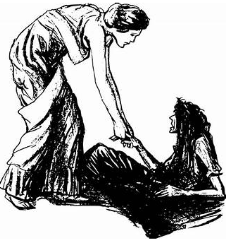
Indispensable as CareGivers are, there is an equally important side to helping people who cannot manage everything for themselves. Whether they are intellectually growing too fast for the mind to manage the pressures such pace brings with it or, perhaps, growing too old to provide the physical strength to handle the routines of life, those on the receiving end of support – The CareGetters – have another need which is often ignored.
As long as we are self-aware we need to be able to see ourselves as useful.
A mendicant will normally be grateful for what s/he receives. The reward they need to acquire for themselves is more subtle. It is the use that they can be to the giver. You see signs of it all over. A picture on the pavement, a pack of tissues pressed into a donor’s hand, a smile of cheer from the flautist playing in the walkway. They may seem to be merely expressions of gratitude. For the CareGetter they are acts of equal care.
An old beggar who sat at the bottom of some steps I had to climb in London did it well. Every day I would give him a small donation. After weekends, or days I had not been going to London for some reason, I would give him coins for any missing days too. He responded to my trivial daily gifts with a short, pithy comment on the state of the world. “Start of the next war, I shouldn’t wonder” or “Seems like summer is about to burst” or “Keep up that pace and you’ll win an Olympic”. News, climate, triumph, crisis – whatever he saw became the basis for his riposte to me. One day he said “Keep going right on, lad”. The next day he wasn’t there.
But his cheerful intervention in my routine never left me. More than seventy years later I can still hear his somewhat croaky voice when I listen in the small hours of the morning. His contribution wasn’t paying for my gift. He was donating something useful in order to be useful himself. It was a brave thing for him to do.
Courage comes in many forms.
Mostly it starts with the mind. A good opening gambit is “I do not have to win to be useful but I do have to be useful to win.” What a compelling basis for structuring a life. It should be the root of all education and the basis of every law.
We daily become more aware of the need for purpose. It drives survival, discipline and effort. The old beggar at the foot of the steps in London could have told me of his departure, which was probably to find somewhere to rest until the end of his life. Instead he gave me an incentive to get on with mine. It doesn’t matter whether I would remember his parting words or not. His encouragement in the launch of my next steps into a career was enough.
We are all CareGetters needing to be useful.
Good morning
John Bittleston
Do you have a CareGetter’s story? Will you share it with us at [email protected]?
23 October 2024