
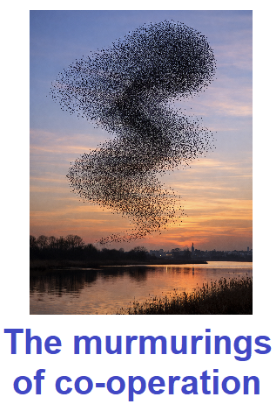
They’re usually starlings, those massive clouds of birds that twist and turn in harmony. They are known as murmurings. Why do they do it? For protection from predators, for warmth and for messages. Motivated by these needs the birds cooperate to distract their enemies, to conserve energy and to talk to each other so that everyone knows what is going on. Maybe we have something to learn from them?
Let’s not get tangled in the autocracy/democracy debate. A village is somewhat cooperative because everyone knows everyone else. If they don’t act in harmony the next village will take over and possibly kill them. A country has the same motivation to be harmonious when it acts cohesively about neighbours, supplies and territorial integrity. We are now threatened by climate upheaval. Why don’t we do the same?
The drone is a cheap vehicle of destructive delivery. Drones are already starting to murmurate, initially at the behest of MAGA, I shouldn’t wonder. AI can’t think but it does such a good job of imitating those who can that it is already ahead of human behavioural imitation. So expect to see murmurations of drone flocks avoiding anti-drone missiles any time now.
Will that convince us of the need to cooperate? Probably not, given our current ability to delude ourselves about what matters. Yet cooperation is not only about survival – it is also about reward. The starlings gain warmth, safety, and shared intelligence when they murmurate. Each bird benefits from the collective, even though it sacrifices a little autonomy in the process. The reward is fewer losses to predators, more energy conserved, and a better chance of surviving.
Politics, at its best, should function in the same way. The reward for cooperation is not abstract – it is stability of institutions, flourishing of communities, and ability to face crises together. When people act in harmony, they gain protection from external threats, conserve resources through shared responsibility, and communicate more effectively about what matters most. The reward is peace, resilience and prosperity.
We often forget that cooperation is not just a moral ideal – it is a practical strategy with dividends. Climate action is not only about preventing catastrophe; it is about reaping the rewards of cleaner air, healthier populations, and sustainable economies. International cooperation on pandemics is not only about avoiding death; it is about securing the reward of restored trust and global mobility. Even in local communities, cooperation yields rewards: safer streets, stronger schools, and vibrant cultural life.
The murmuration of politics is fragile, but it is also fortifying. When citizens twist and turn together, responding to each other with trust and speed, they create patterns that are stronger than any individual flight path. The reward is not only survival – it is the joy of belonging to something larger, the exhilaration of moving as one, and the knowledge that harmony is a form of freedom.
International politics should not be about opposition but about contribution. Contribution demands a common goal. Humans have the intelligence to agree a goal – at present, survival.
Isn’t it time that we did so?
Good morning
John Bittleston