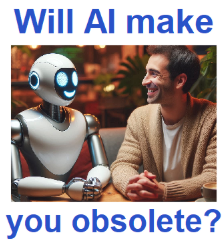
Human beings are unlikely to become obsolete for some time yet. They may do so in the end. That will probably be after your life on earth. More important than obsolescence is change. Humans have been changing for more than 400,000 years as far as we know. In my lifetime, too, we have changed – sometimes significantly. Physically we have developed in mostly minor ways, mentally, in some significant ways and emotionally, dramatically. We have pivoted to think about longevity, health and wealth and less about community, service and obedience. That’s a pretty arbitrary summary but you will get the idea.
Humans now face a challenge unlike any they have had to cope with before. For the first time in our existence we have major control over who and what we will become. There are too many of us for the planet to comfortably cope with. We may develop synthetic foods, refreshed water and purified air but the technological versions of these will change our personalities and behaviour for sure. Unfortunately one of the ways in which we have changed is to become very short-term in our thinking. We reward immediate success and ignore long-term consequences. This is because “live for the moment” has dominated our thinking.
Even if you think this is a highly selfish concept it remains a fact to be dealt with or taken into account. If allowed to flourish, this way of living will drive us to a primitive existence. It will be different from the original primitiveness because of our technological wizardry but it will be more immediately lethal. It may either drive humanity back to something resembling the very early years of our existence or lead us into cataclysmic conflict where a handful of (dinosaurs?) run the rest. We already have a very early glimpse of that regime. We don’t like it.
How we control AI, always assuming that control is possible, will to a large extent determine how humans develop. There are already tentative signs that our intelligence is being adversely affected by our use of AI – and we are barely at the start of its potential. When AI appears to ‘think’ more than we do humans will have insurmountable difficulties in controlling it. In fact the only way to do so then will be to destroy it. That will not be possible since it will have seen us coming.
AI will not, of course, be able to have or express ‘feelings’ or be creative in the way a human can. That, however, is not the point. It will simulate feeling and creativity so well that we will all be kidded into believing it will have the same moral standards as us. Granted these are not currently great but they do imply that we can limit the powers of an alien force that doesn’t already subscribe to them.
For humans to design future humans we must have an educational system of a totally different kind to the one we have now. Personal standards and responsibility must dominate the schedule and ‘process’ must be relegated to a secondary place suitable only for repetitive and mechanised jobs. It takes time to educate people enough to change the culture of a society but there is no other way to do it.
Our focus must be on education. Not the education we are used to but fundamentally addressing the purpose of life. Our competition should be directed at self-development and intellect improvement. AI should become a challenger as well as a tool.
If AI sees us at all, that is how. It’s a challenge we must win.
Or we shall become obsolete.
Good morning
John Bittleston
Views on AI’s impact on humanity are developing hourly. We’d love to hear yours at [email protected].
29 April 2025